代码之家  ›  专栏  ›  技术社区  ›  Kamlesh Shingarakhiya

如何用曲线标注文字?

  •  0
  • Kamlesh Shingarakhiya  · 技术社区  · 4 年前

    我正在寻找一些最新的帮助/提示,关于如何使用 Swift2 对于 iOS9 .我看到了一些非常陈旧的例子,涉及旧的ObjC片段,通常仅限于 OS X 只有在定制的iOS系统中,这可能吗 UIView 子类的 drawRect()

    0 回复  |  直到 10 年前
        1
  •  1
  •   Wolfgang Schreurs    6 年前

    我想说“你试过什么?”,但现在是周五下午,我很早就下班了,所以我利用这个机会翻译了我的旧ObjC代码。就在这里,适合游乐场。把它放在你的视野中应该是微不足道的。

    斯威夫特2
    有关Swift 3&Swift 4更新。。。

    import UIKit
    
    func centreArcPerpendicularText(str: String, context: CGContextRef, radius r: CGFloat, angle theta: CGFloat, colour c: UIColor, font: UIFont, clockwise: Bool){
        // *******************************************************
        // This draws the String str around an arc of radius r,
        // with the text centred at polar angle theta
        // *******************************************************
    
        let l = str.characters.count
        let attributes = [NSFontAttributeName: font]
    
        var characters: [String] = [] // This will be an array of single character strings, each character in str
        var arcs: [CGFloat] = [] // This will be the arcs subtended by each character
        var totalArc: CGFloat = 0 // ... and the total arc subtended by the string
    
        // Calculate the arc subtended by each letter and their total
        for i in 0 ..< l {
            characters += [String(str[str.startIndex.advancedBy(i)])]
            arcs += [chordToArc(characters[i].sizeWithAttributes(attributes).width, radius: r)]
            totalArc += arcs[i]
        }
    
        // Are we writing clockwise (right way up at 12 o'clock, upside down at 6 o'clock)
        // or anti-clockwise (right way up at 6 o'clock)?
        let direction: CGFloat = clockwise ? -1 : 1
        let slantCorrection = clockwise ? -CGFloat(M_PI_2) : CGFloat(M_PI_2)
    
        // The centre of the first character will then be at
        // thetaI = theta - totalArc / 2 + arcs[0] / 2
        // But we add the last term inside the loop
        var thetaI = theta - direction * totalArc / 2
    
        for i in 0 ..< l {
            thetaI += direction * arcs[i] / 2
            // Call centerText with each character in turn.
            // Remember to add +/-90º to the slantAngle otherwise
            // the characters will "stack" round the arc rather than "text flow"
            centreText(characters[i], context: context, radius: r, angle: thetaI, colour: c, font: font, slantAngle: thetaI + slantCorrection)
            // The centre of the next character will then be at
            // thetaI = thetaI + arcs[i] / 2 + arcs[i + 1] / 2
            // but again we leave the last term to the start of the next loop...
            thetaI += direction * arcs[i] / 2
        }
    }
    
    func chordToArc(chord: CGFloat, radius: CGFloat) -> CGFloat {
        // *******************************************************
        // Simple geometry
        // *******************************************************
        return 2 * asin(chord / (2 * radius))
    }
    
    func centreText(str: String, context: CGContextRef, radius r:CGFloat, angle theta: CGFloat, colour c: UIColor, font: UIFont, slantAngle: CGFloat) {
        // *******************************************************
        // This draws the String str centred at the position
        // specified by the polar coordinates (r, theta)
        // i.e. the x= r * cos(theta) y= r * sin(theta)
        // and rotated by the angle slantAngle
        // *******************************************************
    
        // Set the text attributes
        let attributes = [NSForegroundColorAttributeName: c,
            NSFontAttributeName: font]
        // Save the context
        CGContextSaveGState(context)
        // Undo the inversion of the Y-axis (or the text goes backwards!)
        CGContextScaleCTM(context, 1, -1)
        // Move the origin to the centre of the text (negating the y-axis manually)
        CGContextTranslateCTM(context, r * cos(theta), -(r * sin(theta)))
        // Rotate the coordinate system
        CGContextRotateCTM(context, -slantAngle)
        // Calculate the width of the text
        let offset = str.sizeWithAttributes(attributes)
        // Move the origin by half the size of the text
        CGContextTranslateCTM (context, -offset.width / 2, -offset.height / 2) // Move the origin to the centre of the text (negating the y-axis manually)
        // Draw the text
        str.drawAtPoint(CGPointZero, withAttributes: attributes)
        // Restore the context
        CGContextRestoreGState(context)
    }
    
    // *******************************************************
    // Playground code to test
    // *******************************************************
    let size = CGSize(width: 256, height: 256)
    
    UIGraphicsBeginImageContextWithOptions(size, true, 0.0)
    let context = UIGraphicsGetCurrentContext()!
    // *******************************************************************
    // Scale & translate the context to have 0,0
    // at the centre of the screen maths convention
    // Obviously change your origin to suit...
    // *******************************************************************
    CGContextTranslateCTM (context, size.width / 2, size.height / 2)
    CGContextScaleCTM (context, 1, -1)
    
    centreArcPerpendicularText("Hello round world", context: context, radius: 100, angle: 0, colour: UIColor.redColor(), font: UIFont.systemFontOfSize(16), clockwise: true)
    centreArcPerpendicularText("Anticlockwise", context: context, radius: 100, angle: CGFloat(-M_PI_2), colour: UIColor.redColor(), font: UIFont.systemFontOfSize(16), clockwise: false)
    centreText("Hello flat world", context: context, radius: 0, angle: 0 , colour: UIColor.yellowColor(), font: UIFont.systemFontOfSize(16), slantAngle: CGFloat(M_PI_4))
    
    
    let image = UIGraphicsGetImageFromCurrentImageContext()
    UIGraphicsEndImageContext()
    

    输出为: Output
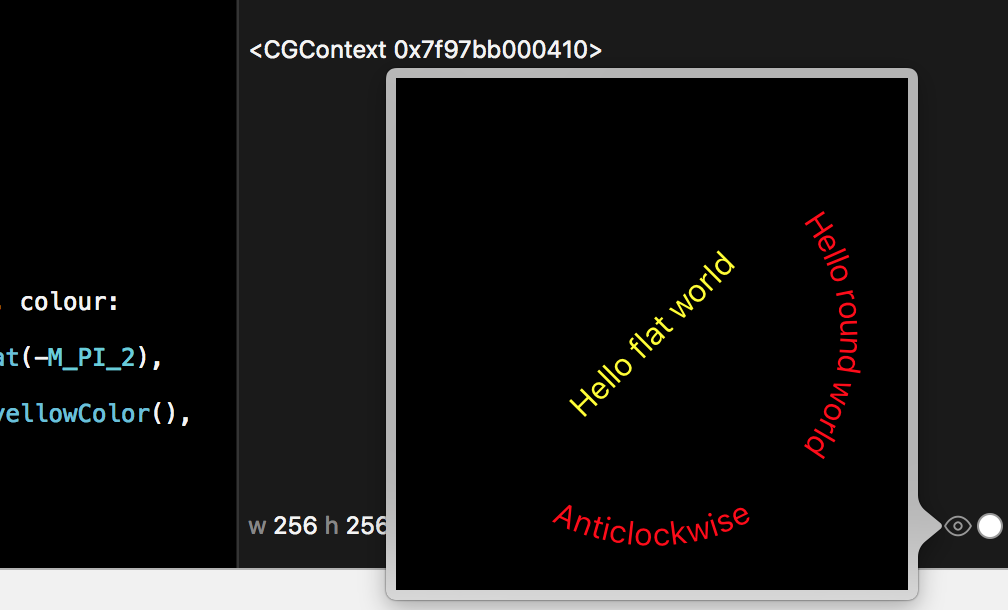
    使现代化 添加顺时针/逆时针&直接的例子。

    更新Swift 3

    func centreArcPerpendicular(text str: String, context: CGContext, radius r: CGFloat, angle theta: CGFloat, colour c: UIColor, font: UIFont, clockwise: Bool){
        // *******************************************************
        // This draws the String str around an arc of radius r,
        // with the text centred at polar angle theta
        // *******************************************************
    
        let l = str.characters.count
        let attributes = [NSFontAttributeName: font]
    
        let characters: [String] = str.characters.map { String($0) } // An array of single character strings, each character in str
        var arcs: [CGFloat] = [] // This will be the arcs subtended by each character
        var totalArc: CGFloat = 0 // ... and the total arc subtended by the string
    
        // Calculate the arc subtended by each letter and their total
        for i in 0 ..< l {
            arcs += [chordToArc(characters[i].size(attributes: attributes).width, radius: r)]
            totalArc += arcs[i]
        }
    
        // Are we writing clockwise (right way up at 12 o'clock, upside down at 6 o'clock)
        // or anti-clockwise (right way up at 6 o'clock)?
        let direction: CGFloat = clockwise ? -1 : 1
        let slantCorrection = clockwise ? -CGFloat(M_PI_2) : CGFloat(M_PI_2)
    
        // The centre of the first character will then be at
        // thetaI = theta - totalArc / 2 + arcs[0] / 2
        // But we add the last term inside the loop
        var thetaI = theta - direction * totalArc / 2
    
        for i in 0 ..< l {
            thetaI += direction * arcs[i] / 2
            // Call centerText with each character in turn.
            // Remember to add +/-90º to the slantAngle otherwise
            // the characters will "stack" round the arc rather than "text flow"
            centre(text: characters[i], context: context, radius: r, angle: thetaI, colour: c, font: font, slantAngle: thetaI + slantCorrection)
            // The centre of the next character will then be at
            // thetaI = thetaI + arcs[i] / 2 + arcs[i + 1] / 2
            // but again we leave the last term to the start of the next loop...
            thetaI += direction * arcs[i] / 2
        }
    }
    
    func chordToArc(_ chord: CGFloat, radius: CGFloat) -> CGFloat {
        // *******************************************************
        // Simple geometry
        // *******************************************************
        return 2 * asin(chord / (2 * radius))
    }
    
    func centre(text str: String, context: CGContext, radius r:CGFloat, angle theta: CGFloat, colour c: UIColor, font: UIFont, slantAngle: CGFloat) {
        // *******************************************************
        // This draws the String str centred at the position
        // specified by the polar coordinates (r, theta)
        // i.e. the x= r * cos(theta) y= r * sin(theta)
        // and rotated by the angle slantAngle
        // *******************************************************
    
        // Set the text attributes
        let attributes = [NSForegroundColorAttributeName: c,
                          NSFontAttributeName: font]
        // Save the context
        context.saveGState()
        // Undo the inversion of the Y-axis (or the text goes backwards!)
        context.scaleBy(x: 1, y: -1)
        // Move the origin to the centre of the text (negating the y-axis manually)
        context.translateBy(x: r * cos(theta), y: -(r * sin(theta)))
        // Rotate the coordinate system
        context.rotate(by: -slantAngle)
        // Calculate the width of the text
        let offset = str.size(attributes: attributes)
        // Move the origin by half the size of the text
        context.translateBy (x: -offset.width / 2, y: -offset.height / 2) // Move the origin to the centre of the text (negating the y-axis manually)
        // Draw the text
        str.draw(at: CGPoint(x: 0, y: 0), withAttributes: attributes)
        // Restore the context
        context.restoreGState()
    }
    
    // *******************************************************
    // Playground code to test
    // *******************************************************
    let size = CGSize(width: 256, height: 256)
    
    UIGraphicsBeginImageContextWithOptions(size, true, 0.0)
    let context = UIGraphicsGetCurrentContext()!
    // *******************************************************************
    // Scale & translate the context to have 0,0
    // at the centre of the screen maths convention
    // Obviously change your origin to suit...
    // *******************************************************************
    context.translateBy (x: size.width / 2, y: size.height / 2)
    context.scaleBy (x: 1, y: -1)
    
    centreArcPerpendicular(text: "Hello round world", context: context, radius: 100, angle: 0, colour: UIColor.red, font: UIFont.systemFont(ofSize: 16), clockwise: true)
    centreArcPerpendicular(text: "Anticlockwise", context: context, radius: 100, angle: CGFloat(-M_PI_2), colour: UIColor.red, font: UIFont.systemFont(ofSize: 16), clockwise: false)
    centre(text: "Hello flat world", context: context, radius: 0, angle: 0 , colour: UIColor.yellow, font: UIFont.systemFont(ofSize: 16), slantAngle: CGFloat(M_PI_4))
    
    
    let image = UIGraphicsGetImageFromCurrentImageContext()
    UIGraphicsEndImageContext()
    

    斯威夫特4
    再一次,微小的改变,这一次修复了对 M_PI , String 放弃 .characters 中的参数标签更改 .size(withAttributes... ,以及文本属性的更改 NSAttributedStringKey 枚举。。。

    import UIKit
    
    func centreArcPerpendicular(text str: String, context: CGContext, radius r: CGFloat, angle theta: CGFloat, colour c: UIColor, font: UIFont, clockwise: Bool){
        // *******************************************************
        // This draws the String str around an arc of radius r,
        // with the text centred at polar angle theta
        // *******************************************************
    
        let characters: [String] = str.map { String($0) } // An array of single character strings, each character in str
        let l = characters.count
        let attributes = [NSAttributedStringKey.font: font]
    
        var arcs: [CGFloat] = [] // This will be the arcs subtended by each character
        var totalArc: CGFloat = 0 // ... and the total arc subtended by the string
    
        // Calculate the arc subtended by each letter and their total
        for i in 0 ..< l {
            arcs += [chordToArc(characters[i].size(withAttributes: attributes).width, radius: r)]
            totalArc += arcs[i]
        }
    
        // Are we writing clockwise (right way up at 12 o'clock, upside down at 6 o'clock)
        // or anti-clockwise (right way up at 6 o'clock)?
        let direction: CGFloat = clockwise ? -1 : 1
        let slantCorrection: CGFloat = clockwise ? -.pi / 2 : .pi / 2
    
        // The centre of the first character will then be at
        // thetaI = theta - totalArc / 2 + arcs[0] / 2
        // But we add the last term inside the loop
        var thetaI = theta - direction * totalArc / 2
    
        for i in 0 ..< l {
            thetaI += direction * arcs[i] / 2
            // Call centerText with each character in turn.
            // Remember to add +/-90º to the slantAngle otherwise
            // the characters will "stack" round the arc rather than "text flow"
            centre(text: characters[i], context: context, radius: r, angle: thetaI, colour: c, font: font, slantAngle: thetaI + slantCorrection)
            // The centre of the next character will then be at
            // thetaI = thetaI + arcs[i] / 2 + arcs[i + 1] / 2
            // but again we leave the last term to the start of the next loop...
            thetaI += direction * arcs[i] / 2
        }
    }
    
    func chordToArc(_ chord: CGFloat, radius: CGFloat) -> CGFloat {
        // *******************************************************
        // Simple geometry
        // *******************************************************
        return 2 * asin(chord / (2 * radius))
    }
    
    func centre(text str: String, context: CGContext, radius r: CGFloat, angle theta: CGFloat, colour c: UIColor, font: UIFont, slantAngle: CGFloat) {
        // *******************************************************
        // This draws the String str centred at the position
        // specified by the polar coordinates (r, theta)
        // i.e. the x= r * cos(theta) y= r * sin(theta)
        // and rotated by the angle slantAngle
        // *******************************************************
    
        // Set the text attributes
        let attributes = [NSAttributedStringKey.foregroundColor: c, NSAttributedStringKey.font: font]
        //let attributes = [NSForegroundColorAttributeName: c, NSFontAttributeName: font]
        // Save the context
        context.saveGState()
        // Undo the inversion of the Y-axis (or the text goes backwards!)
        context.scaleBy(x: 1, y: -1)
        // Move the origin to the centre of the text (negating the y-axis manually)
        context.translateBy(x: r * cos(theta), y: -(r * sin(theta)))
        // Rotate the coordinate system
        context.rotate(by: -slantAngle)
        // Calculate the width of the text
        let offset = str.size(withAttributes: attributes)
        // Move the origin by half the size of the text
        context.translateBy (x: -offset.width / 2, y: -offset.height / 2) // Move the origin to the centre of the text (negating the y-axis manually)
        // Draw the text
        str.draw(at: CGPoint(x: 0, y: 0), withAttributes: attributes)
        // Restore the context
        context.restoreGState()
    }
    
    // *******************************************************
    // Playground code to test
    // *******************************************************
    let size = CGSize(width: 256, height: 256)
    
    UIGraphicsBeginImageContextWithOptions(size, true, 0.0)
    let context = UIGraphicsGetCurrentContext()!
    // *******************************************************************
    // Scale & translate the context to have 0,0
    // at the centre of the screen maths convention
    // Obviously change your origin to suit...
    // *******************************************************************
    context.translateBy (x: size.width / 2, y: size.height / 2)
    context.scaleBy(x: 1, y: -1)
    
    centreArcPerpendicular(text: "Hello round 🌏 world", context: context, radius: 100, angle: 0, colour: UIColor.red, font: UIFont.systemFont(ofSize: 16), clockwise: true)
    centreArcPerpendicular(text: "Anticlockwise", context: context, radius: 100, angle: CGFloat(-M_PI_2), colour: UIColor.red, font: UIFont.systemFont(ofSize: 16), clockwise: false)
    centre(text: "Hello flat world", context: context, radius: 0, angle: 0 , colour: UIColor.yellow, font: UIFont.systemFont(ofSize: 16), slantAngle: .pi / 4)
    
    
    let image = UIGraphicsGetImageFromCurrentImageContext()
    UIGraphicsEndImageContext()
    

    更新以显示在UIView中的使用

    评论员@RitVikupadhayaya询问如何在 UIView -对老手来说很明显,但对初学者来说可能不是。诀窍是使用 UIGraphicsGetCurrentContext 没有 使命感 UIGraphicsBeginImageContextWithOptions (这将覆盖 UIView 的上下文作为 现在的 因此你的 UIView 应该是这样的:

    class MyView: UIView {
        override func draw(_ rect: CGRect) {
            guard let context = UIGraphicsGetCurrentContext() else { return }
            let size = self.bounds.size
    
            context.translateBy (x: size.width / 2, y: size.height / 2)
            context.scaleBy (x: 1, y: -1)
    
            centreArcPerpendicular(text: "Hello round world", context: context, radius: 100, angle: 0, colour: UIColor.red, font: UIFont.systemFont(ofSize: 16), clockwise: true)
            centreArcPerpendicular(text: "Anticlockwise", context: context, radius: 100, angle: CGFloat(-M_PI_2), colour: UIColor.red, font: UIFont.systemFont(ofSize: 16), clockwise: false)
            centre(text: "Hello flat world", context: context, radius: 0, angle: 0 , colour: UIColor.yellow, font: UIFont.systemFont(ofSize: 16), slantAngle: CGFloat(M_PI_4))
        }
    }

    
        2
  •  0
  •   Faiz Ul Hassan    5 年前

    @循环路径上UILabel的IBDesignable

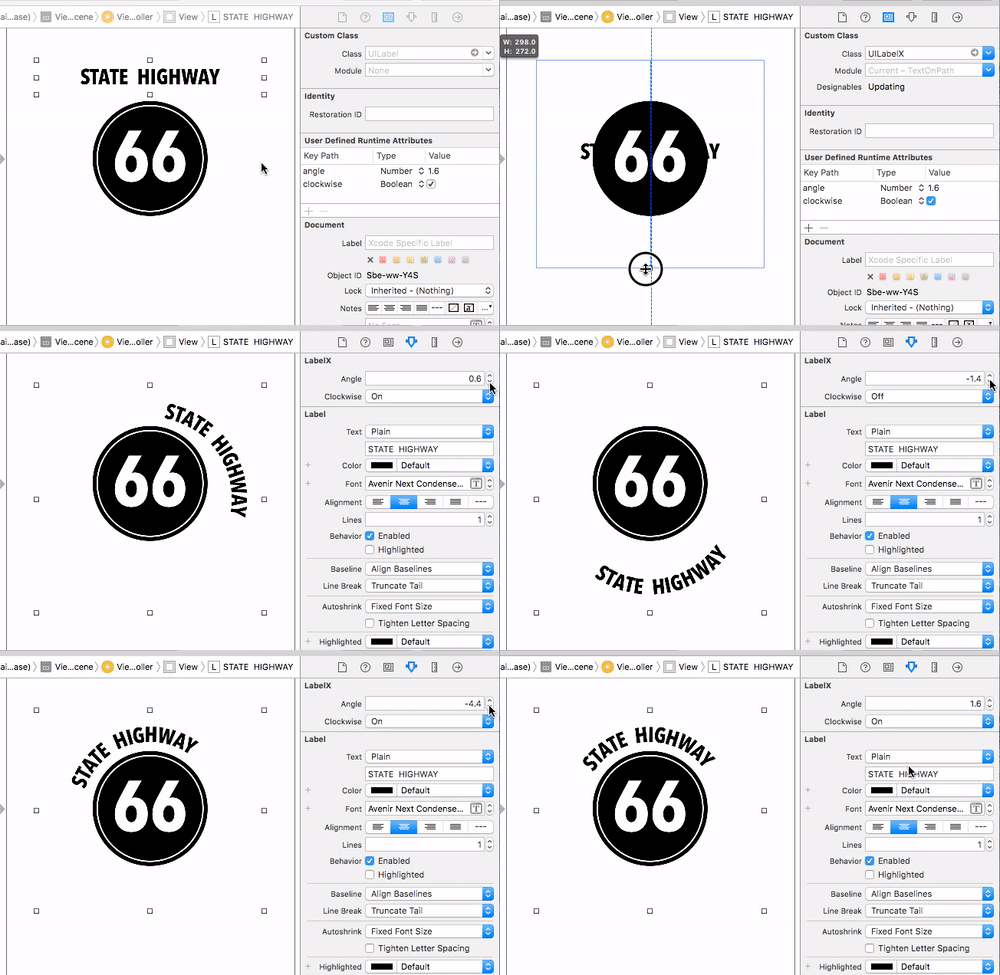
    首先,我想我们都同意@Grimxn就是那个人!他的解决方案很有效。我把他的作品重构成一个定制的UILabel控件,你可以在情节提要上设置和编辑它。如果你们看了我的视频,你们就会知道我是多么喜欢做这件事!

    自定义UILabel的Swift 3代码

    import UIKit
    
    @IBDesignable
    class UILabelX: UILabel {
        // *******************************************************
        // DEFINITIONS (Because I'm not brilliant and I'll forget most this tomorrow.)
        // Radius: A straight line from the center to the circumference of a circle.
        // Circumference: The distance around the edge (outer line) the circle.
        // Arc: A part of the circumference of a circle. Like a length or section of the circumference.
        // Theta: A label or name that represents an angle.
        // Subtend: A letter has a width. If you put the letter on the circumference, the letter's width
        //          gives you an arc. So now that you have an arc (a length on the circumference) you can
        //          use that to get an angle. You get an angle when you draw a line from the center of the
        //          circle to each end point of your arc. So "subtend" means to get an angle from an arc.
        // Chord: A line segment connecting two points on a curve. If you have an arc then there is a
        //          start point and an end point. If you draw a straight line from start point to end point
        //          then you have a "chord".
        // sin: (Super simple/incomplete definition) Or "sine" takes an angle in degrees and gives you a number.
        // asin: Or "asine" takes a number and gives you an angle in degrees. Opposite of sine.
        //          More complete definition: http://www.mathsisfun.com/sine-cosine-tangent.html
        // cosine: Also takes an angle in degrees and gives you another number from using the two radiuses (radii).
        // *******************************************************
        
        @IBInspectable var angle: CGFloat = 1.6
        @IBInspectable var clockwise: Bool = true
        
        override func draw(_ rect: CGRect) {
            centreArcPerpendicular()
        }
        
        /**
         This draws the self.text around an arc of radius r,
         with the text centred at polar angle theta
         */
        func centreArcPerpendicular() {
            guard let context = UIGraphicsGetCurrentContext() else { return }
            let str = self.text ?? ""
            let size = self.bounds.size
            context.translateBy(x: size.width / 2, y: size.height / 2)
            
            let radius = getRadiusForLabel()
            let l = str.characters.count
            let attributes: [String : Any] = [NSFontAttributeName: self.font]
            
            let characters: [String] = str.characters.map { String($0) } // An array of single character strings, each character in str
            var arcs: [CGFloat] = [] // This will be the arcs subtended by each character
            var totalArc: CGFloat = 0 // ... and the total arc subtended by the string
            
            // Calculate the arc subtended by each letter and their total
            for i in 0 ..< l {
                arcs += [chordToArc(characters[i].size(attributes: attributes).width, radius: radius)]
                totalArc += arcs[i]
            }
            
            // Are we writing clockwise (right way up at 12 o'clock, upside down at 6 o'clock)
            // or anti-clockwise (right way up at 6 o'clock)?
            let direction: CGFloat = clockwise ? -1 : 1
            let slantCorrection = clockwise ? -CGFloat(M_PI_2) : CGFloat(M_PI_2)
            
            // The centre of the first character will then be at
            // thetaI = theta - totalArc / 2 + arcs[0] / 2
            // But we add the last term inside the loop
            var thetaI = angle - direction * totalArc / 2
            
            for i in 0 ..< l {
                thetaI += direction * arcs[i] / 2
                // Call centre with each character in turn.
                // Remember to add +/-90º to the slantAngle otherwise
                // the characters will "stack" round the arc rather than "text flow"
                centre(text: characters[i], context: context, radius: radius, angle: thetaI, slantAngle: thetaI + slantCorrection)
                // The centre of the next character will then be at
                // thetaI = thetaI + arcs[i] / 2 + arcs[i + 1] / 2
                // but again we leave the last term to the start of the next loop...
                thetaI += direction * arcs[i] / 2
            }
        }
        
        func chordToArc(_ chord: CGFloat, radius: CGFloat) -> CGFloat {
            // *******************************************************
            // Simple geometry
            // *******************************************************
            return 2 * asin(chord / (2 * radius))
        }
        
        /**
         This draws the String str centred at the position
         specified by the polar coordinates (r, theta)
         i.e. the x= r * cos(theta) y= r * sin(theta)
         and rotated by the angle slantAngle
        */
        func centre(text str: String, context: CGContext, radius r:CGFloat, angle theta: CGFloat, slantAngle: CGFloat) {
            // Set the text attributes
            let attributes = [NSForegroundColorAttributeName: self.textColor,
                              NSFontAttributeName: self.font] as [String : Any]
            // Save the context
            context.saveGState()
            // Move the origin to the centre of the text (negating the y-axis manually)
            context.translateBy(x: r * cos(theta), y: -(r * sin(theta)))
            // Rotate the coordinate system
            context.rotate(by: -slantAngle)
            // Calculate the width of the text
            let offset = str.size(attributes: attributes)
            // Move the origin by half the size of the text
            context.translateBy(x: -offset.width / 2, y: -offset.height / 2) // Move the origin to the centre of the text (negating the y-axis manually)
            // Draw the text
            str.draw(at: CGPoint(x: 0, y: 0), withAttributes: attributes)
            // Restore the context
            context.restoreGState()
        }
        
        func getRadiusForLabel() -> CGFloat {
            // Imagine the bounds of this label will have a circle inside it.
            // The circle will be as big as the smallest width or height of this label.
            // But we need to fit the size of the font on the circle so make the circle a little
            // smaller so the text does not get drawn outside the bounds of the circle.
            let smallestWidthOrHeight = min(self.bounds.size.height, self.bounds.size.width)
            let heightOfFont = self.text?.size(attributes: [NSFontAttributeName: self.font]).height ?? 0
            
            // Dividing the smallestWidthOrHeight by 2 gives us the radius for the circle.
            return (smallestWidthOrHeight/2) - heightOfFont + 5
        }
    }
    

    故事板上的用法示例

    Text on Path Usage

    我做的改变

    • 我删除了可以直接从标签上获取的参数。
    • 无可否认,我在三角函数方面不是最聪明的,在我这个年纪已经忘记了很多,所以我加入了所有相关的定义,这样我就可以开始理解@Grimxn brillianty了。
    • 这个 角 和 顺时针方向的 设置现在是可以在属性检查器中调整的属性。
    • 我现在根据标签的大小创建半径。
    • 把一些标准格式的评论放在函数上,你知道,这样你就可以看到弹出的选项+点击函数。

    Help Text Example

    我看到的问题

    我鼓励您编辑以上内容以改进它。

    • 我不知道为什么,但有时标签会在其他控件上呈现,即使它在文档大纲中位于它们的后面。
        3
  •  0
  •   Yunus Tek    4 年前

    始终使用相同的实现,但根据需要进行了调整 斯威夫特4

    import UIKit
    
    @IBDesignable
    class CircularLabel: UILabel {
        // *******************************************************
        // DEFINITIONS (Because I'm not brilliant and I'll forget most this tomorrow.)
        // Radius: A straight line from the center to the circumference of a circle.
        // Circumference: The distance around the edge (outer line) the circle.
        // Arc: A part of the circumference of a circle. Like a length or section of the circumference.
        // Theta: A label or name that represents an angle.
        // Subtend: A letter has a width. If you put the letter on the circumference, the letter's width
        //          gives you an arc. So now that you have an arc (a length on the circumference) you can
        //          use that to get an angle. You get an angle when you draw a line from the center of the
        //          circle to each end point of your arc. So "subtend" means to get an angle from an arc.
        // Chord: A line segment connecting two points on a curve. If you have an arc then there is a
        //          start point and an end point. If you draw a straight line from start point to end point
        //          then you have a "chord".
        // sin: (Super simple/incomplete definition) Or "sine" takes an angle in degrees and gives you a number.
        // asin: Or "asine" takes a number and gives you an angle in degrees. Opposite of sine.
        //          More complete definition: http://www.mathsisfun.com/sine-cosine-tangent.html
        // cosine: Also takes an angle in degrees and gives you another number from using the two radiuses (radii).
        // *******************************************************
    
        @IBInspectable var angle: CGFloat = 1.6
        @IBInspectable var clockwise: Bool = true
    
        override func draw(_ rect: CGRect) {
            centreArcPerpendicular()
        }
        /**
        This draws the self.text around an arc of radius r,
        with the text centred at polar angle theta
        */
        func centreArcPerpendicular() {
            guard let context = UIGraphicsGetCurrentContext() else { return }
            let string = text ?? ""
            let size   = bounds.size
            context.translateBy(x: size.width / 2, y: size.height / 2)
    
            let radius = getRadiusForLabel()
            let l = string.count
            let attributes = [NSAttributedStringKey.font : self.font!]
    
            let characters: [String] = string.map { String($0) } // An array of single character strings, each character in str
            var arcs: [CGFloat] = [] // This will be the arcs subtended by each character
            var totalArc: CGFloat = 0 // ... and the total arc subtended by the string
    
            // Calculate the arc subtended by each letter and their total
            for i in 0 ..< l {
                arcs += [chordToArc(characters[i].size(withAttributes: attributes).width, radius: radius)]
                totalArc += arcs[i]
            }
    
            // Are we writing clockwise (right way up at 12 o'clock, upside down at 6 o'clock)
            // or anti-clockwise (right way up at 6 o'clock)?
            let direction: CGFloat = clockwise ? -1 : 1
            let slantCorrection = clockwise ? -CGFloat.pi/2 : CGFloat.pi/2
    
            // The centre of the first character will then be at
            // thetaI = theta - totalArc / 2 + arcs[0] / 2
            // But we add the last term inside the loop
            var thetaI = angle - direction * totalArc / 2
    
            for i in 0 ..< l {
                thetaI += direction * arcs[i] / 2
                // Call centre with each character in turn.
                // Remember to add +/-90º to the slantAngle otherwise
                // the characters will "stack" round the arc rather than "text flow"
                centre(text: characters[i], context: context, radius: radius, angle: thetaI, slantAngle: thetaI + slantCorrection)
                // The centre of the next character will then be at
                // thetaI = thetaI + arcs[i] / 2 + arcs[i + 1] / 2
                // but again we leave the last term to the start of the next loop...
                thetaI += direction * arcs[i] / 2
            }
        }
    
        func chordToArc(_ chord: CGFloat, radius: CGFloat) -> CGFloat {
            // *******************************************************
            // Simple geometry
            // *******************************************************
            return 2 * asin(chord / (2 * radius))
        }
    
        /**
        This draws the String str centred at the position
        specified by the polar coordinates (r, theta)
        i.e. the x= r * cos(theta) y= r * sin(theta)
        and rotated by the angle slantAngle
        */
        func centre(text str: String, context: CGContext, radius r:CGFloat, angle theta: CGFloat, slantAngle: CGFloat) {
            // Set the text attributes
            let attributes : [NSAttributedStringKey : Any] = [
                NSAttributedStringKey.foregroundColor: textColor!,
                NSAttributedStringKey.font: font!
                ]
            // Save the context
            context.saveGState()
            // Move the origin to the centre of the text (negating the y-axis manually)
            context.translateBy(x: r * cos(theta), y: -(r * sin(theta)))
            // Rotate the coordinate system
            context.rotate(by: -slantAngle)
            // Calculate the width of the text
            let offset = str.size(withAttributes: attributes)
            // Move the origin by half the size of the text
            context.translateBy(x: -offset.width / 2, y: -offset.height / 2) // Move the origin to the centre of the text (negating the y-axis manually)
            // Draw the text
            str.draw(at: CGPoint(x: 0, y: 0), withAttributes: attributes)
            // Restore the context
            context.restoreGState()
        }
    
        func getRadiusForLabel() -> CGFloat {
            // Imagine the bounds of this label will have a circle inside it.
            // The circle will be as big as the smallest width or height of this label.
            // But we need to fit the size of the font on the circle so make the circle a little
            // smaller so the text does not get drawn outside the bounds of the circle.
            let smallestWidthOrHeight = min(bounds.size.height, bounds.size.width)
            let heightOfFont = text?.size(withAttributes: [NSAttributedStringKey.font: self.font]).height ?? 0
    
            // Dividing the smallestWidthOrHeight by 2 gives us the radius for the circle.
            return (smallestWidthOrHeight/2) - heightOfFont + 5
        }
    }